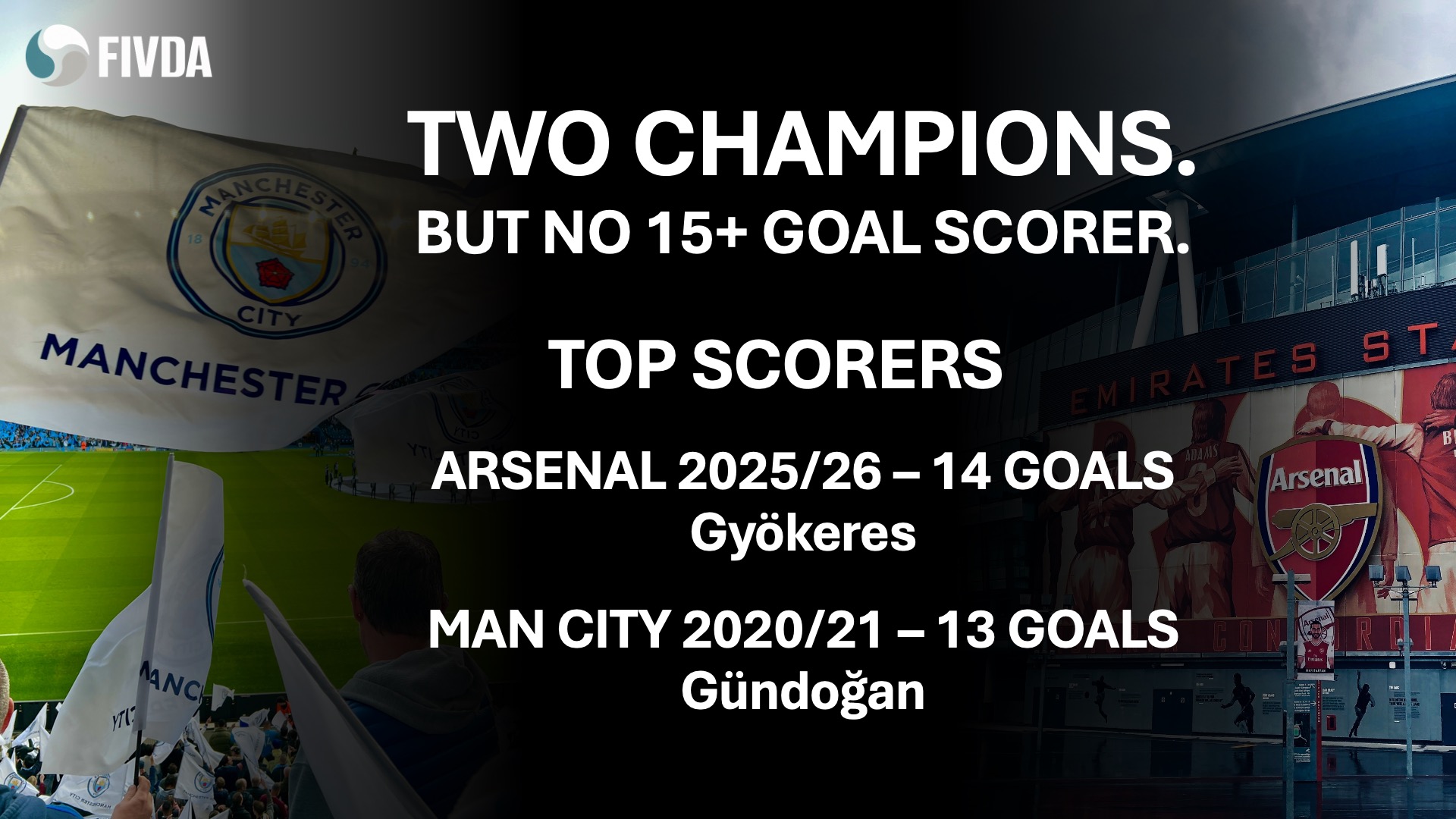
Arsenal won the 2025/26 Premier League title with 85 points, yet not one of their players scored 15 league goals.
Viktor Gyökeres finished as the club’s leading scorer with 14. For a title-winning side, that is a surprisingly modest individual return, particularly in an era when Erling Haaland and Mohamed Salah have produced extraordinary goalscoring seasons.
But Arsenal are not the only recent champions to win without a prolific individual scorer.
Of the six Premier League champions between 2020/21 and 2025/26, two lifted the trophy without anybody reaching 15 league goals. The other was Manchester City in 2020/21, when İlkay Gündoğan led Pep Guardiola’s side with just 13.
The 15-goal mark is a threshold chosen for this comparison, not a requirement for winning the league. It provides a useful way to ask how often recent champions have relied on an individual capable of reaching that total.
Arsenal followed an unusual Manchester City example
According to FBref’s 2025/26 Premier League table, Arsenal finished champions with 85 points, despite Gyökeres being their highest individual league scorer with 14 goals.
The closest comparison is Manchester City’s 2020/21 campaign. City collected 86 points to win the title, with Gündoğan leading their league scoring chart on 13, as shown in the Premier League’s Manchester City records.
The similarities are striking. Both teams won the league with their leading scorer contributing fewer than 15 goals, and their final points totals were separated by just one point.
That does not mean the teams played alike or relied on identical attacking approaches. The goalscoring figures alone cannot establish that. What they demonstrate is that a Premier League champion does not necessarily need one player producing 20 or 30 league goals.
Indeed, City’s following title offers a useful contrast. In 2021/22, Kevin De Bruyne scored 15 Premier League goals as City finished champions with 93 points.
He reached the threshold exactly, making Arsenal and City’s 2020/21 side the only two qualifying champions in this six-season comparison.
How the six champions compare
The difference becomes clearer when every champion’s leading goalscorer is placed side by side.
| Season | Champions | Leading league scorer | Goals |
|---|---|---|---|
| 2020/21 | Manchester City | İlkay Gündoğan | 13 |
| 2021/22 | Manchester City | Kevin De Bruyne | 15 |
| 2022/23 | Manchester City | Erling Haaland | 36 |
| 2023/24 | Manchester City | Erling Haaland | 27 |
| 2024/25 | Liverpool | Mohamed Salah | 29 |
| 2025/26 | Arsenal | Viktor Gyökeres | 14 |

Caption: Arsenal’s Viktor Gyökeres scored 14 league goals in 2025/26. Of the six champions examined, only Manchester City’s 2020/21 side had a lower leading-scorer total, with İlkay Gündoğan scoring 13.
The contrast with Haaland’s first Manchester City season is particularly dramatic. He scored 36 league goals in 2022/23, when City secured another title with 89 points, according to the club’s 2022/23 season review.
Haaland followed that with 27 league goals as City won again in 2023/24.
Liverpool’s 2024/25 title provides another example of a champion with a prolific individual scorer. Mohamed Salah finished with 29 league goals, earning the Golden Boot according to Liverpool’s official season records.
Across just six seasons, the leading scorer’s contribution therefore ranged from Gündoğan’s 13 to Haaland’s 36.
Yet every team in the comparison finished in exactly the same position: first.
Does a champion need a prolific goalscorer?
The results demonstrate that Premier League champions can finish top with very different contributions from their leading individual scorers.
Some champions have benefited from extraordinary returns by one player. Others have finished top without anyone approaching those totals.
However, this comparison does not establish that spreading goals across a squad is inherently better than relying heavily on one scorer. The analysis compares each champion’s leading goalscorer, not the complete distribution of goals throughout their squads. A team’s title chances also depend on much more than its leading individual’s contribution, including its overall attacking output and defensive results.
Nor should the finding be interpreted as an all-time Premier League record. FIVDA examined the six completed seasons from 2020/21 to 2025/26, not every title-winning team since the competition began.
What makes Arsenal’s achievement interesting is the contrast with the recent champions immediately preceding them.
Haaland’s 36-goal campaign and Salah’s 29-goal season show how influential an exceptional individual goalscorer can be. Arsenal’s 2025/26 title, like Manchester City’s in 2020/21, demonstrates that such an individual return is not essential.
Having a player score at least 15 league goals is one way to power a title challenge. But two of the last six Premier League champions proved that it is not a prerequisite for lifting the trophy.
Main image is by Jonny Gios on Pexels and Who’s Denilo ? on Pexels.