
January transfer windows are usually judged through fees, goals and reputation. But before asking whether a signing was good, there is a simpler question worth answering:
Did the player actually become part of the Premier League team?
FIVDA reconstructed the senior first-team arrivals from January 2026, calculated how much Premier League football remained available to each player after joining and compared that opportunity with the minutes they actually played. The resulting utilisation rate reveals several very different kinds of winter recruitment.
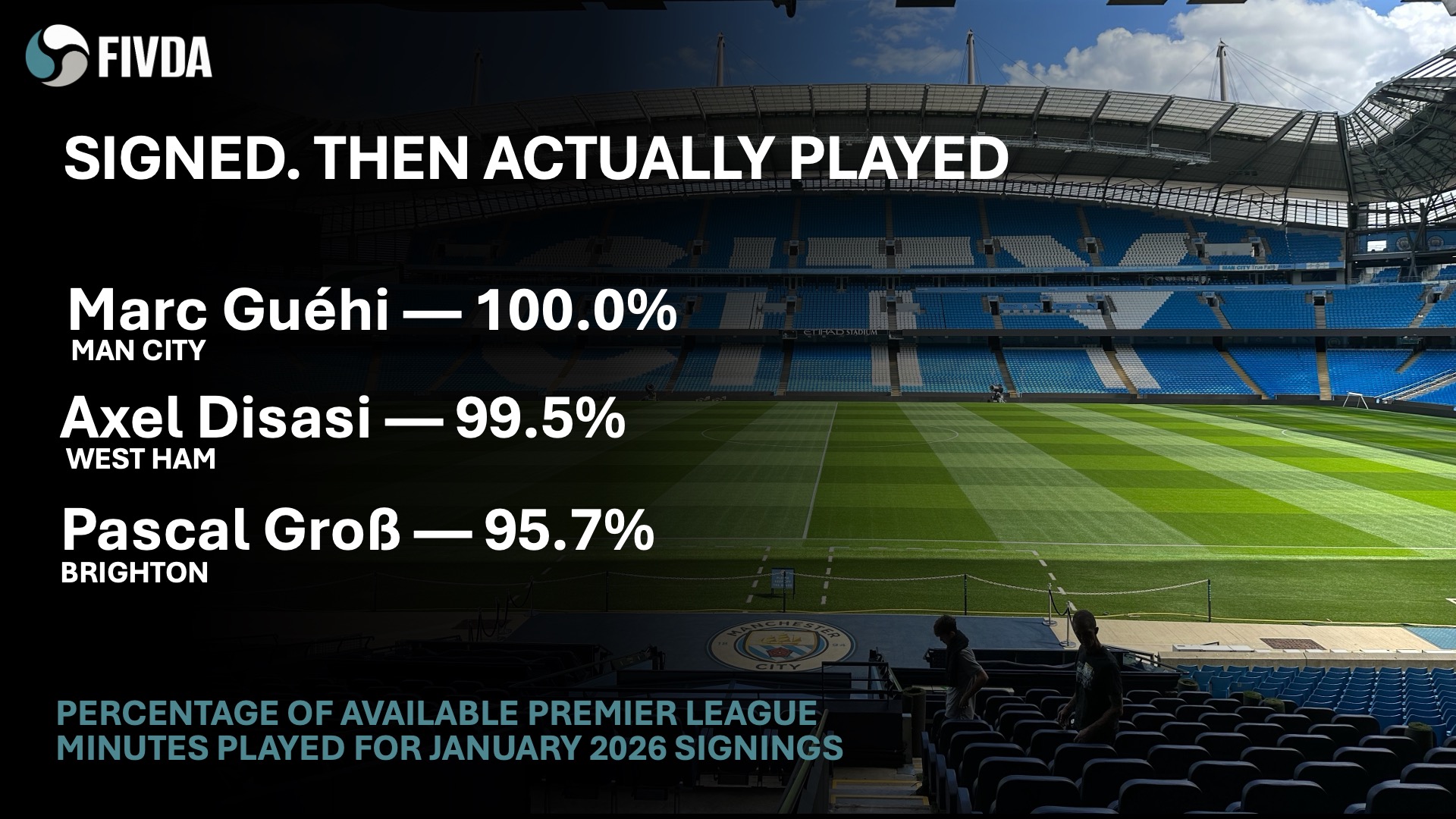
Brighton received 1,636 of the 1,710 league minutes available to Pascal Groß, or 95.7%. Manchester City’s two major additions combined for 95.4% utilisation. At the other end, some senior arrivals barely featured.
That does not make high utilisation synonymous with a successful transfer. Instead, it shows something conventional transfer grades often miss: clubs were buying very different things in January — immediate starters, replacements, rotation players, emergency cover and future capacity.
The denominator transfer grades usually ignore
Raw minutes are a poor way to compare January signings because players arrived at different times. Someone signed on 2 January had considerably more football available than a deadline-day arrival.
FIVDA therefore defines a player’s eligible minutes as 90 multiplied by the number of Premier League fixtures remaining from his first eligible match. Utilisation is then simply the player’s league minutes after joining divided by those eligible team minutes. Transfer dates were reconstructed using records including BBC Sport’s January transfer record.
The denominator deliberately does not remove matches missed through injury. That would answer a different question: how often did the manager use the player when medically available? Here, the question is how much immediate playing capacity the club actually received.
The distinction matters. Utilisation is not an impact score. Ninety minutes of poor football are not automatically more valuable than an excellent 30-minute substitute appearance. Nor does a high percentage prove good value or a low one prove recruitment failure.
It measures playing time supplied, and nothing more. That makes utilisation a useful companion to FIVDA’s previous analysis of whether expensive Premier League transfers justified their cost: before judging value or performance, this measure asks whether the signing actually entered the league side.
Five January signings exceeded 90%
Only five of the 28 qualifying arrivals played at least 90% of their available Premier League minutes.
Marc Guéhi leads the ranking. Manchester City signed Guéhi on 19 January while dealing with injuries to several senior centre-backs. He then went directly into the league XI: FBref records Guéhi with 15 starts and 1,350 minutes.
That was every available league minute after he became eligible: 100% utilisation.
Axel Disasi was almost as ever-present. West Ham signed Disasi on loan on deadline day as they attempted to reinforce a defence struggling in the relegation battle. He subsequently started all 14 available matches and played 1,254 of approximately 1,260 minutes — 99.5% according to FBref’s Disasi record.
Pascal Groß ranks third at 95.7%, followed by Antoine Semenyo at 91.3% and Adam Armstrong at 90.5%.

Figure 1 — Which January Signings Used the Most Available Premier League Minutes?
The list already tells us something important about January recruitment. These were not five versions of the same transfer. They included a centre-back signed amid an injury problem, a deadline-day defender joining a relegation fight, an experienced player returning to his former club, a major attacking acquisition and a striker arriving after his new club sold another forward.
Their common feature was not role or transfer profile.
It was immediate integration.
Brighton and Manchester City reached the same place differently
At club level, the most interesting comparison is between the top two.
Brighton had one qualifying senior arrival: Groß. The club brought Groß back from Borussia Dortmund on 2 January, with Fabian Hürzeler highlighting his experience, leadership and ability.
He subsequently made 19 league appearances, starting 18 and playing 1,636 minutes, according to FBref’s Brighton record. Against 1,710 eligible minutes, that produced Brighton’s 95.7% club utilisation rate.
Manchester City reached almost exactly the same figure through two signings. Guéhi played 100% of his available minutes, while City’s signing of Antoine Semenyo on 9 January was followed by 17 league starts. FBref records Semenyo with 1,397 minutes, equivalent to 91.3% of the 1,530 available.
Together, City’s two arrivals supplied 2,747 of 2,880 available minutes: 95.4%.

Figure 2 — Which Clubs Converted January Recruitment Into First-Team Minutes?
The similarity is more revealing than simply declaring either window “better”. Brighton concentrated their qualifying business in one experienced returning player. City added two players who immediately became regular starters. Different strategies produced almost identical levels of league utilisation.
What FIVDA can establish is that both clubs converted almost all the league opportunity available to their qualifying January recruits into actual playing time.
January recruitment was not one thing
The 28 qualifying arrivals spread widely across the utilisation scale. Five exceeded 90%, three fell between 75% and 89.9%, while nine finished below 25%, including the two unused goalkeepers.

Figure 3 — January Recruitment Was Not One Thing
That distribution suggests several different recruitment types.
Guéhi, Groß, Semenyo and Disasi became immediate structural starters. Armstrong resembles a direct replacement: Wolves signed Armstrong alongside Angel Gomes on deadline day after selling Jørgen Strand Larsen to Crystal Palace, and FBref records Armstrong with 14 starts and 1,140 minutes.
Other arrivals supplied rotation or depth rather than near-ever-present football. Some barely entered the league side at all.
None of those categories automatically determines whether the recruitment was intelligent. A club can need emergency cover, a reserve goalkeeper or a player intended to contribute more substantially in future seasons. That distinction between immediate first-team contribution and longer-term squad planning also matters in FIVDA’s analysis of Chelsea’s recruitment strategy.
Conversely, a signing playing almost every minute does not prove the club recruited well.
That is why utilisation works best as a starting point rather than a transfer grade.
Bournemouth show what a club average can hide
Bournemouth produced almost the opposite pattern.
Their four qualifying arrivals combined for only 22.8% utilisation, but that aggregate disguises radically different individual roles.
Rayan played 1,111 of 1,350 available minutes — 82.3%. FBref records Rayan with 15 league appearances, 13 starts, five goals and two assists. He clearly became a substantial part of the league side.
Alex Tóth, by contrast, played 140 minutes, equivalent to 9.7% utilisation. Goalkeepers Fraser Forster and Christos Mandas played none: FBref records no Premier League appearances for Forster, while Mandas also recorded no league appearances during his Bournemouth loan.

Figure 4 — Bournemouth’s January Window Contained Four Completely Different Playing-Time Outcomes
Calling Bournemouth’s January recruitment simply “22.8% utilised” therefore loses much of the story. They had one heavily used arrival, one lightly used young midfielder and two senior goalkeepers who did not play in the league.
The goalkeeper cases also show why low utilisation cannot automatically mean failure. A reserve goalkeeper can fulfil a squad role without appearing in a league match. The metric tells us Bournemouth received no Premier League minutes from those two signings; it cannot tell us whether acquiring them was a mistake.
West Ham show why utilisation is not success
West Ham are the necessary warning against treating the ranking as a transfer-window league table.
Their four qualifying arrivals combined for 3,582 minutes from 5,940 available, a utilisation rate of 60.3%. That placed them fifth among clubs with qualifying senior recruitment.
Disasi led the group at 99.5%. Valentín Castellanos was another substantial addition: FBref records Castellanos with 1,384 minutes, 17 starts and six goals, giving him 85.4% utilisation. Pablo supplied another 823 minutes, while Adama Traoré played only 121.
The new players therefore entered West Ham’s side substantially. Yet the club were still relegated.
That separation is fundamental to interpreting the metric. Utilisation tells us whether recruitment changed the first team. It cannot tell us whether the changed team was good enough.
Disasi demonstrates the point particularly well. Playing 99.5% of his available league minutes establishes that West Ham immediately integrated him. It does not establish that he solved their defensive problems, nor that the transfer itself should be judged a success.

Figure 5 — West Ham Used Their January Signings — But Still Went Down
Low utilisation raises a question rather than answering one
The more interesting low-utilisation cases are senior outfield arrivals who supplied very little league football.
Leeds signed Facundo Buonanotte on loan on 15 January, but FBref records only 39 Premier League minutes. Against approximately 1,530 eligible minutes, that is just 2.5% utilisation.
Lorenzo Lucca supplied Nottingham Forest with 129 minutes, or 9.0% of those available to him. Adama Traoré also finished at 9.0% for West Ham despite making nine appearances: FBref’s West Ham data records only 121 minutes and no starts.
That Traoré example explains why appearance totals can mislead. Nine appearances sounds like meaningful involvement until the actual minutes reveal that they amounted to roughly one full match plus half an hour spread across the remainder of the season.
But low utilisation still does not explain why a player was used sparingly. Without additional evidence, it should prompt a recruitment question rather than answer one.
January analysis usually begins by asking how good a signing was. The 2025/26 window suggests there is a question that logically comes first:
Did the signing actually become part of the Premier League team?
Brighton and Manchester City converted more than 95% of the league minutes available to their qualifying January arrivals into playing time. West Ham integrated several signings heavily and were relegated anyway. Bournemouth combined one regular with two goalkeepers who never appeared in the league. Leeds received just 39 league minutes from Buonanotte’s loan.
Those are very different recruitment outcomes.
Playing time cannot tell us which signing was best. What it can tell us — more clearly than a conventional list of fees, goals and reputations — is what January actually changed about the squad on the pitch.
Main image is by Yoohaina Edwards on Pexels.


