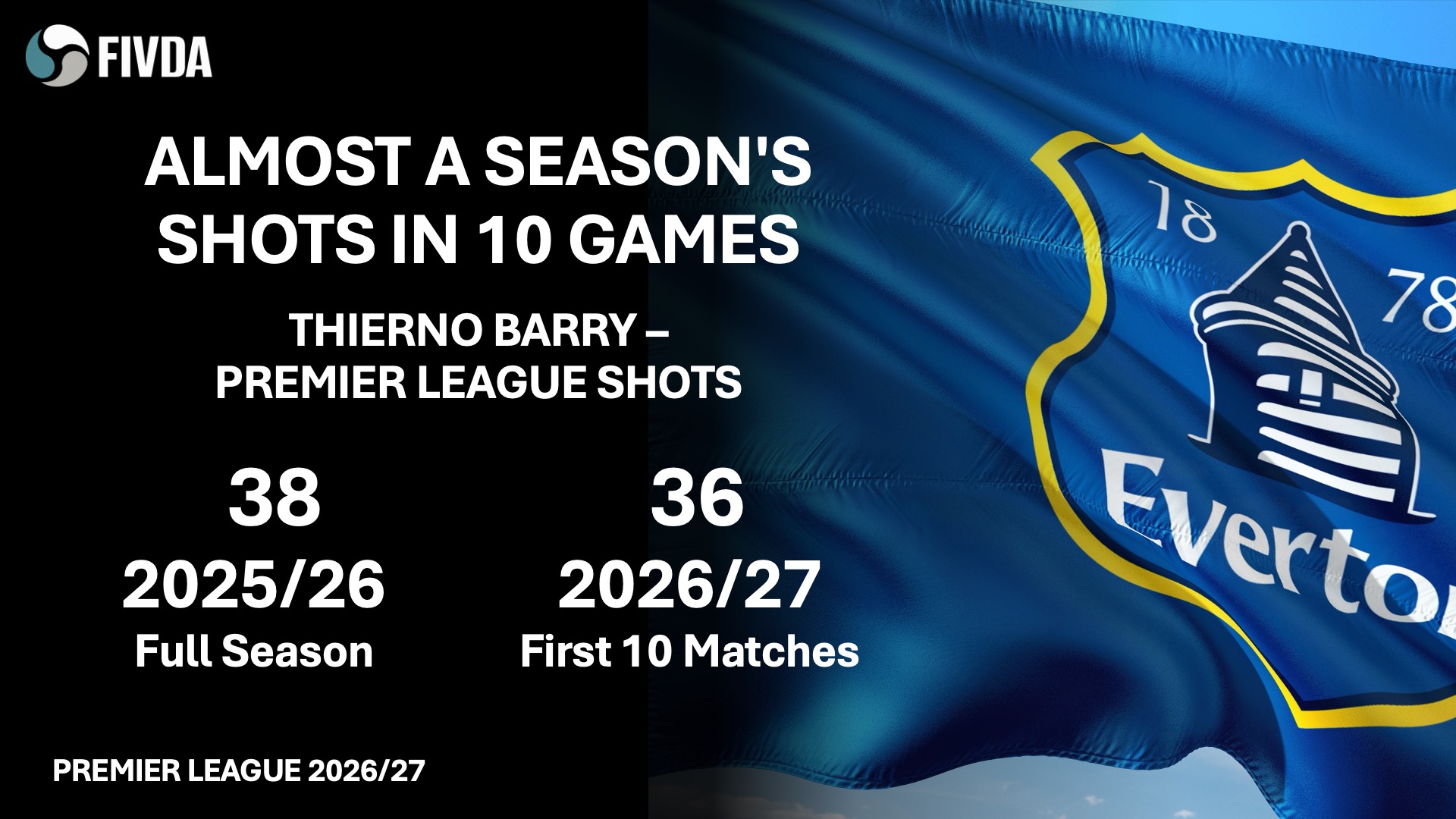
Thierno Barry attempted 38 shots across the entire 2025/26 Premier League season. Just ten matches into 2026/27, the Everton striker has already taken 36.
That is almost 95% of his previous season’s shot total in less than half the playing time.
His increased attacking involvement was on full display against Coventry City on 6 November. Barry scored twice and assisted Everton’s third goal in a 3–1 victory.
It was the kind of performance that illustrated his growing influence in Everton’s attack. But the more interesting question is what has changed across his two Premier League campaigns.
Barry is scoring more frequently, yet the underlying figures suggest his improvement is primarily associated with getting more shooting opportunities rather than becoming a more clinical finisher.
The comparison covers the complete 2025/26 Premier League season and Everton’s opening ten matches of 2026/27, ending 8 November 2026.
From substitute appearances to a regular starting role
Barry’s first Premier League season was very different from his current campaign.
According to FBref’s Everton 2025/26 statistics, he made 38 league appearances but started only 21 matches.
Across 1,914 minutes, Barry averaged approximately 50 minutes per appearance. Seventeen of his outings came from the bench.
Through Everton’s opening ten league fixtures of 2026/27, he has started every match, averaging approximately 85 minutes per appearance, according to his current-season match log.
For a centre-forward, that additional playing time matters. More minutes provide more opportunities to participate in attacks, receive service and get into shooting positions.
However, Barry’s increase in shots cannot be explained simply by spending longer on the pitch. His shooting frequency has changed even more dramatically.
Barry is taking more than twice as many shots
FIVDA compared Barry’s attacking output per 90 minutes to account for the substantial difference in playing time between the two seasons.
His shooting frequency has increased from 1.79 to 3.81 shots per 90, a rise of 113%.
The underlying totals are supported by Barry’s 2025/26 shooting record and 2026/27 shooting statistics.
Even when both seasons are adjusted to the same amount of playing time, Barry is attempting more than twice as many shots.

Thierno Barry’s shots per 90 have more than doubled between the full 2025/26 Premier League season and the first ten matches of 2026/27. His expected goals and actual goals per 90 have also increased. The figures show a substantial rise in shooting opportunities without establishing improved finishing efficiency.
The improvement extends beyond shot volume.
Using the Premier League’s expected goals figures alongside FBref playing time, FIVDA calculated that Barry’s xG per 90 has approximately doubled, from 0.38 to 0.77.
Expected goals estimates the likelihood of scoring from shooting opportunities. Barry’s higher rate indicates that he is accumulating substantially more expected scoring value during his time on the pitch.
The Premier League’s goalscoring analysis adds another revealing detail.
Barry recorded 18 big chances throughout 2025/26. In his opening ten matches this season, he has already recorded 22.
That provides further evidence of how much more frequently he is becoming involved in dangerous attacking situations.
It does not establish whether improved movement, different service or tactical changes are responsible. What is clear is that Barry is now getting considerably more opportunities to score.
More goals do not necessarily mean better finishing
Barry’s increased involvement has been accompanied by more frequent goals.
He scored eight times in 1,914 minutes last season, averaging 0.38 goals per 90. Through Matchweek 10, he has scored six in 851 minutes, increasing that rate to 0.63.
His performance against Coventry offered a vivid example.
According to Everton’s official match report, Barry headed home Vitalii Mykolenko’s cross to equalise before converting a second opportunity from Tyrique George’s delivery. He then supplied the pass for Kiernan Dewsbury-Hall’s goal.
Two finishes and an assist demonstrated his contribution in one match. However, they cannot tell us whether his finishing efficiency has improved over the season.
For that, comparing goals with expected goals provides useful context.
FIVDA explored a similar distinction in its analysis of Brighton’s goalscoring and expected goals in 2025/26, where the underlying numbers helped separate the chances being created from how effectively they were finished.
Barry scored eight goals from 8.11 xG in 2025/26, almost exactly matching the expected total.
This season, he has scored six from 7.28 xG.
His goals-minus-xG figure has consequently moved from −0.11 to −1.28.
That does not prove Barry has become a worse finisher, particularly over just ten matches. But neither does it support the idea that greater finishing efficiency explains his improved goalscoring rate.
The stronger explanation is the substantial increase in opportunities he is taking.
A more involved Everton goalscorer
Barry’s early-season transformation is not simply about scoring more goals.
The distinction between chances and outcomes also featured in FIVDA’s analysis of Premier League expected-goal overperformance in 2025/26, which found that Everton’s attacking goals were almost exactly in line with their expected goals across the previous season.
He has moved from starting 21 of 38 league appearances to starting all ten matches this season. More importantly, he is attempting shots at more than twice his previous rate, even after accounting for playing time.
His six goals reflect that increased attacking involvement, although the comparison remains between a completed season and only ten matches of the next.
Barry has not yet demonstrated that he has become a better finisher. He has demonstrated something equally important for a centre-forward: he is getting far more chances to finish.
That is the real story behind a striker who has almost matched an entire season’s shooting total before reaching his eleventh league appearance.